
15
JanuaryAbortion in Dubai +971556394139 Abortion Pills in Dubai / Abortion in the UAE: Law, Safety, Options, and Facts
abortion laws in Dubai and the UAE in 2024. Understand the legal status, penalties, medical risks of abortion pills, and legal alternatives for pregnancy termination.Navigating questions about abortion pills in Dubai and abortion in the UAE is complex, involving strict legal statutes, profound medical considerations, and significant personal implications. Misinformation can lead to severe legal consequences and serious health risks. This authoritative guide synthesizes current UAE federal law, Dubai healthcare regulations, clinical guidelines, and public health data to provide a clear, factual, and essential resource. Our goal is to inform individuals about the precise legal status of abortion in the UAE, the severe restrictions on medical termination of pregnancy, and the critical importance of seeking safe, legal pathways for reproductive healthcare.

1. Understanding Abortion in the UAE: Medical Definitions and Context
Abortion, medically defined as the termination of a pregnancy before the fetus can survive outside the uterus, is categorized into two primary types: medical and surgical.
Medical Abortion: This involves using pharmaceutical drugs, commonly referred to as abortion pills, to induce the termination. The globally recognized regimen combines two medications: mifepristone and misoprostol. Mifepristone blocks the hormone progesterone, and misoprostol causes uterine contractions to expel the pregnancy tissue.
Surgical Abortion: This is a clinical procedure, such as vacuum aspiration or dilation and curettage (D&C), performed by a qualified healthcare provider in a medical setting.
In the UAE, public health policy is shaped by a combination of civil law and Islamic jurisprudence (Sharia). The law strongly protects the fetus from the moment of conception, permitting termination only under highly specific, legally-defined circumstances. Understanding this framework is crucial before considering any form of pregnancy termination in Dubai.
2. Legal Status of Abortion in Dubai & the UAE: A Strict Framework
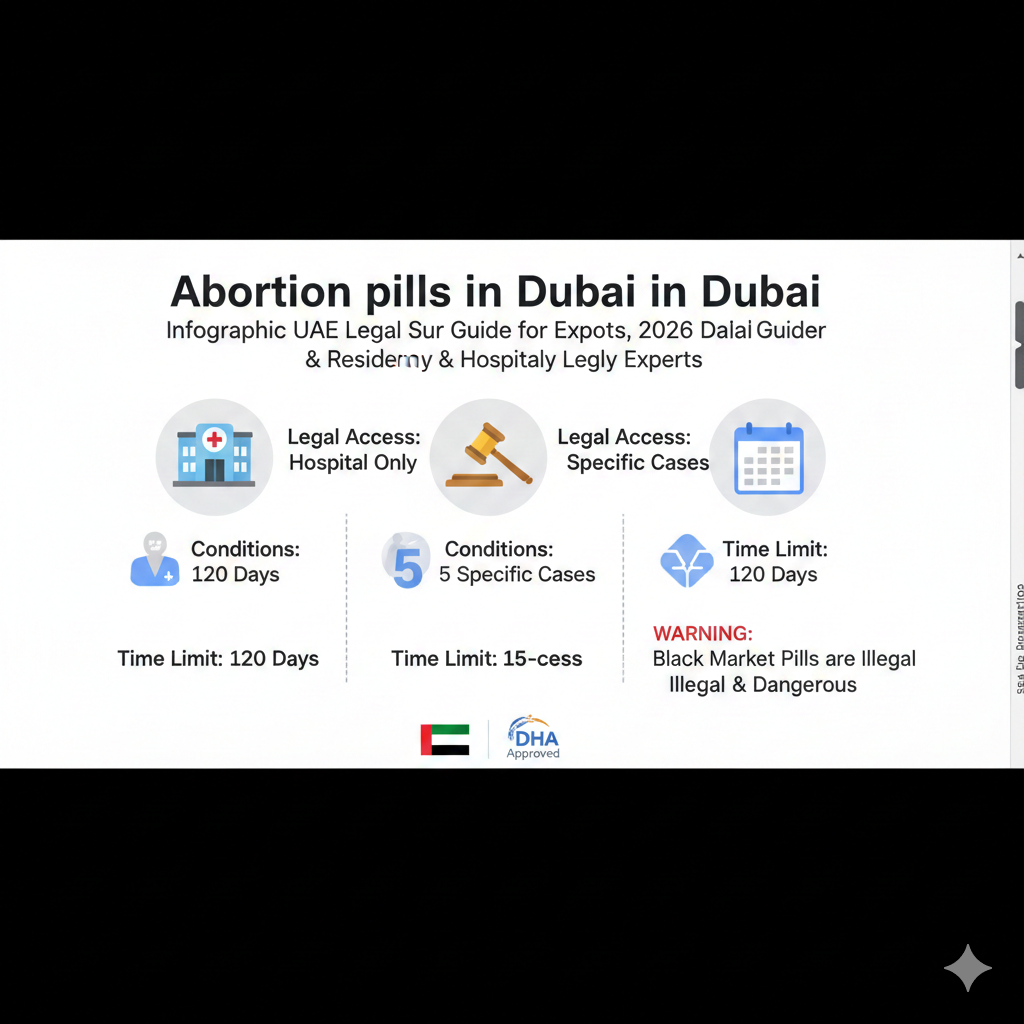
The UAE's legal stance on abortion is explicitly defined in Federal Law No. (7) of 2019 Concerning Medical Liability, its amendments, and the Federal Penal Code. Abortion is illegal except in a very narrow set of circumstances (Sources: UAE Federal Law, Legal 500, Mohammad Al Najjar Advocates, GAPD Database).
Legal Grounds for Abortion
A licensed physician may perform an abortion only if a committee of at least three specialist doctors certifies that continuing the pregnancy:
Endangers the life of the pregnant woman.
Poses a serious threat to her physical or mental health.
Notably, while laws in some other Gulf nations, like Oman, explicitly include severe fetal anomalies as a ground for termination (Source: The Role of Law in Shaping Regulations...in Oman), the UAE law does not explicitly cite fetal anomalies alone as a legal ground. The threat must be to the mother's health, which may be interpreted in cases of a non-viable fetus causing psychological harm, but this requires rigorous medical-legal certification.
Penalties for Illegal Abortion
The penalties for violating these laws are severe and apply to all parties involved:
| Action / Party Involved | Potential Penalty (Under UAE Penal Code) | Source |
|---|---|---|
| The Person Undergoing the Abortion | Imprisonment for up to one year and/or a significant fine. | HL&A, UAE Penal Code |
| The Provider (Doctor/Pharmacist) | Harsher imprisonment, larger fines, and permanent revocation of medical license. Deportation for expatriates. | Legal 500, HL&A |
| Anyone Who Assists or Supplies Drugs | Similar criminal prosecution as an accomplice. | Mohammad Al Najjar Advocates |
Key Takeaway: There is no concept of "abortion on request" or for socio-economic reasons in the UAE. Any termination outside the narrow legal window is a criminal offense.
3. Are Abortion Pills Allowed in Dubai? Availability and Legal Constraints
The term "abortion pills" specifically refers to the drugs mifepristone and misoprostol.
Legal Status of the Drugs: Mifepristone and misoprostol are strictly controlled prescription medications in the UAE. They are not available over-the-counter and are classified under the Ministry of Health's list of controlled medicines (Source: UAE Embassy in Stockholm - Controlled Medicines List). Their import, sale, or possession without explicit medical authorization for a legal termination is a crime.
Prescription and Use: These medications may only be prescribed and administered within a licensed hospital setting after the mandated medical committee has approved the termination. A woman cannot legally obtain a prescription for abortion pills in Dubai for self-administration at home outside of this supervised process.
The Danger of Illicit Channels: Seeking these pills online, through unlicensed pharmacies, or via mail-order services (a practice studied in other jurisdictions, as noted in Mail-order pharmacy dispensing... - PubMed) is extremely dangerous in the UAE. It risks prosecution, exposure to counterfeit drugs, and lack of critical medical supervision, leading to severe health complications.
4. Medical Abortion vs. Surgical Abortion: The Legal UAE Context
If a termination is legally approved by the hospital committee, the method used will be determined by medical professionals based on gestational age and the patient's health.
Medical Abortion (Using Pills): This may be an option in early pregnancy. It is a multi-day process conducted under strict inpatient or outpatient observation to manage pain, bleeding, and confirm completion.
Surgical Abortion: Often used for later gestational ages or for immediate management, this is a procedure performed in an operating room or clinic under sedation or anesthesia.
In the UAE, both methods are only legal within the confines of an approved medical case in a licensed facility.
5. How a Legal Medical Abortion Works: The Clinical Process
For a patient with a committee-approved case, a medical termination of pregnancy in Dubai follows a strict protocol aligned with 2024 Clinical Policy Guidelines for Abortion Care and WHO recommendations (Medical management of induced abortion).
Typical Medical Abortion Timeline in a Supervised Setting:
| Day | Step | Process & Medication |
|---|---|---|
| Day 1 (Hospital) | Pre-Assessment & Mifepristone | Patient is assessed. A dose of mifepristone is administered orally under supervision. |
| 24-48 Hours Later | Misoprostol Administration | The patient returns or remains under observation. Misoprostol tablets are taken buccally (in the cheek) or vaginally as prescribed. |
| Following Hours | Expulsion | Uterine cramping and bleeding occur, expelling the pregnancy tissue. Pain management and monitoring are provided. |
| Follow-up (1-2 weeks) | Confirmation | A follow-up ultrasound or blood test is mandatory to confirm the termination is complete and to rule out complications. |
6. Safety, Risks, and Complications of Abortion Pills
Even in a legal, supervised setting, medical abortion carries risks that necessitate professional care.
Common Side Effects: Severe cramping, heavy bleeding (potentially requiring transfusion), nausea, vomiting, diarrhea, chills, and fever.
Serious Complications: Incomplete abortion (tissue remains, requiring surgical intervention), infection, hemorrhage, and allergic reactions.
The Critical Role of Supervision: Access to emergency medical care is non-negotiable. The safety profile documented in clinical studies depends entirely on the use of genuine medications and the availability of immediate surgical backup—conditions absent in illegal, unsupervised use.
7. Where People Seek Care: Clinics, Hospitals, and Telemedicine
Legal Pathway: All legal abortions must be performed in government or licensed private hospitals after committee review. There are no standalone "abortion clinics" in the UAE as understood in more permissive jurisdictions.
Telemedicine: Given the legal requirement for in-person committee review and supervised administration, telemedicine for abortion pill provision is not a legal or viable option in the UAE. Any service offering this is operating outside the law and poses immense risk.
8. Cost & Accessibility Barriers
For an approved case, costs can be significant, covering hospital fees, specialist consultations, and the committee review. For expatriates, insurance coverage is highly variable and often excludes elective or legally complex procedures. The primary barrier, however, is not cost but meeting the stringent legal criteria for approval.
9. Alternatives and Support Services
Given the restrictive laws, individuals are encouraged to explore all alternatives and support systems:
Prenatal Counseling and Support: Organizations and hospital social workers can provide counseling for unintended pregnancies, discussing options like continuing the pregnancy.
Adoption: While also governed by complex family laws, adoption may be an alternative path to explore confidentially with authorities.
Reproductive Health Education: Accessing reliable contraception to prevent unintended pregnancies is a critical component of reproductive health in the UAE.
Mental Health Support: Counseling services are available to address the stress and anxiety surrounding an unintended pregnancy or a severe fetal diagnosis.
10. Frequently Asked Questions (FAQs)
Q1: Is it legal to buy or use abortion pills in Dubai without a hospital's permission?
A: No. It is a criminal offense to purchase, possess, or use mifepristone and misoprostol for the purpose of abortion without the approval of a designated hospital committee. This can lead to imprisonment and deportation.
Q2: What should I do if I have an unwanted pregnancy in the UAE?
A: Your first step should be to consult with a gynecologist at a licensed hospital. They can provide confidential counseling, explain the legal landscape, discuss legal grounds for termination if applicable, and connect you with support services for all options, including prenatal care.
Q3: Can foreign residents or tourists access abortion services in Dubai?
A: The same federal laws apply to everyone in the UAE, regardless of nationality or residency status. There are no exceptions for tourists. Foreign residents would require the same committee approval within the UAE health system.
Q4: Are there any proposed changes to make abortion laws less strict?
A: While the UAE has undergone significant legal reforms in many areas, there have been no official proposals or indications of plans to liberalize the abortion laws. The current framework, rooted in Federal Law No. (7) of 2019, remains firmly in place (Sources: UAE Abortion Law: Comprehensive Guide, Understanding the UAE's New Abortion Law).
Q5: What are the medical risks of taking abortion pills obtained online?
A: Risks include incomplete abortion leading to sepsis, severe hemorrhage from undiagnosed ectopic pregnancy, toxic shock from counterfeit drugs, and failure of the medication leading to continuation of pregnancy. Without follow-up care, these complications can be fatal.
11. Conclusion & Critical Call to Action
The landscape for abortion in the UAE is defined by clear, restrictive laws designed to protect the fetus with exceptions only for grave maternal health threats. The pursuit of abortion pills in Dubai through unofficial channels is legally perilous and medically dangerous.
Your safest and only legal course of action is to engage directly with the official healthcare system. Schedule a consultation with a specialist in a reputable hospital to receive accurate medical advice, understand your legal position, and access appropriate support and care. Prioritizing your health and safety within the bounds of the law is paramount.
Disclaimer: This article is for informational purposes only and does not constitute legal or medical advice. UAE laws are subject to change. For definitive guidance on your specific situation, you must consult with a licensed UAE healthcare provider and a qualified legal professional in the Emirates.

مراجعات